 Chicago Works
How to Report Graffiti in Chicago — and Get It Removed Free
Yes, it's really free: Chicago's Graffiti Removal program cleans tags off homes, garages, fences, and businesses at no cost to the property owner. All it takes is a 311 request — and a photo makes it work much better.
Chicago removes graffiti for free
Chicago's long-running graffiti removal program — known for years as Graffiti Blasters, run under Streets & Sanitation — removes tags from both public and private property at no charge. Crews typically use one of two methods depending on the surface:
- Blasting — a baking-soda-based blast that strips paint from unpainted brick, stone, and masonry.
- Paint-over — matching paint applied over tags on painted surfaces, metal, and similar materials.
The crew picks the method for the surface, so your job is simply to tell 311 exactly where the tag is and what it's on.
How to file a graffiti removal request
Three official routes, one queue: call 311 (312-744-5000 from outside the city), file at 311.chicago.gov, or submit through an Open311 app like Chicago Works. Include:
- The exact address of the tagged property. If the tag faces the alley, say so — “garage door facing the alley behind 1234 N Example Ave” sends the crew to the right side of the building.
- The surface — brick wall, garage door, fence, roll-down gate, dumpster. This tells the crew which equipment they'll need.
- A photo — the single most useful thing you can attach. Crews find the exact spot faster, and the request is harder to close as “not found.”
What happens after you file
You'll get a service request (SR) number, and the request is routed to the removal crews. The tag needs to be reachable from the public way or visible to the crew at the address given; interior courtyards and locked areas are harder. Status runs open → in progress → closed, which you can follow with your SR number or automatically in the Chicago Works Service Tracker.
If the same wall keeps getting hit, keep reporting it. Each removal is a fresh request, and repeat locations help the city see the pattern. Fast, repeated cleanup is the proven playbook here: taggers want their work seen, and a wall that gets wiped within days stops being worth hitting.
Two nuances worth knowing. First, the service targets vandalism — a commissioned mural on your own building isn't something to report, and crews aren't there to referee art disputes. Second, filing a request for a tag on someone else's property is fine and normal; you don't need to be the owner to report graffiti that's visible from the street or alley.
Why an app is the natural way to report graffiti
Graffiti reporting is photo-first by nature, and that's exactly the flow Chicago Works is built around:
- Snap the tag as you walk past — the photo attaches straight to the request.
- Auto-locate — GPS pins the address and detects your ward; drag the pin onto the exact building or alley face.
- Choose Graffiti Removal and submit. It files directly with the city's official Open311 system — no phone call, no sign-up.
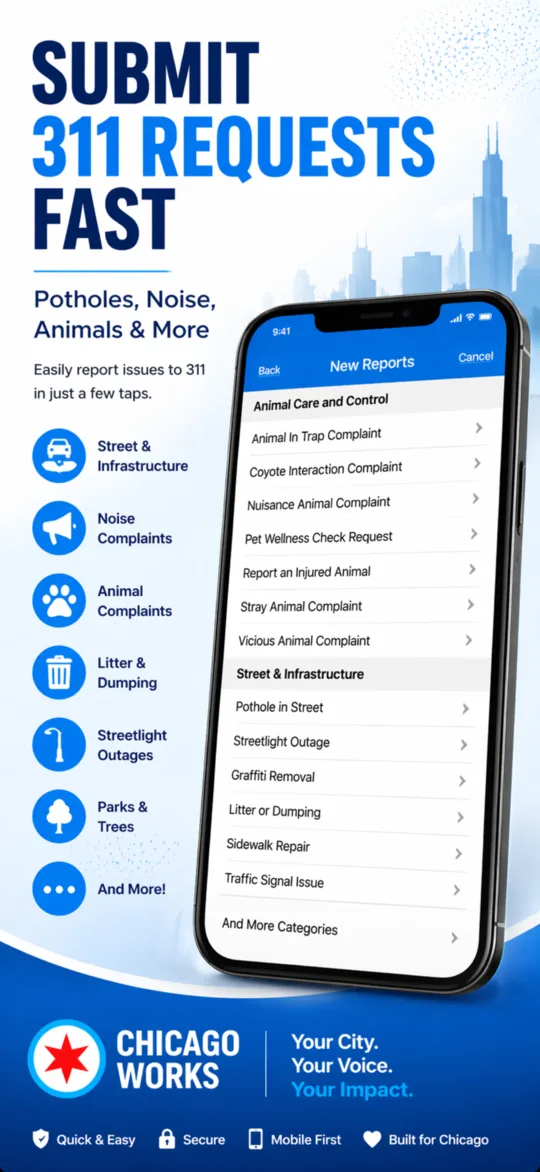
The whole thing takes less time than the hold music would. And because the app saves reports offline, you can file from a viaduct or underpass — prime tagging territory with lousy signal — and it syncs when you're back in coverage.
Get that tag gone
Photograph the tag, let the app pin the address, submit a Graffiti Removal request in seconds — then watch it move to “closed.”
Download on theApp Store Free · iPhone & iPad · Also on Google Play · Works in all 50 wards