 Chicago Works
The Chicago 311 App, Explained: How Chicago 311 Actually Works
311 is Chicago's front door for every non-emergency city service — potholes, rats, graffiti, streetlights, garbage. Here's how the system works, every official way to file a request, and where a 311 app fits in.
What Chicago 311 is
Chicago 311 (branded CHI311) is the city's single intake system for non-emergency services and information. Instead of figuring out which department handles rats versus potholes versus dead trees, you file one request with 311 and the system routes it: potholes to CDOT, garbage and graffiti to Streets & Sanitation, trees to the Bureau of Forestry, rats to the Bureau of Rodent Control, and so on across dozens of request types.
Every request gets a service request (SR) number — your receipt and your tracking code. Requests move through a standard lifecycle: open when filed, in progress when assigned, closed when the department finishes (or determines no action is needed). Anything that's an emergency — fire, crime in progress, medical, downed live wires — is 911, never 311.
Every official way to file a 311 request
- Phone: dial 311 inside the city, or 312-744-5000 from outside city limits. An operator files for you. It works, but you wait on hold and describe locations out loud.
- Web: 311.chicago.gov lets you search service types, submit requests, and look up any SR number. Solid at a desk; clunky on a sidewalk.
- Apps built on Open311: Chicago publishes an official Open311 interface — a public standard that lets apps file requests directly into the same municipal queue the call center and website use. That's what Chicago Works uses. Same queue, same SR numbers, same city crews — just a faster front end.
Why an app beats the phone (and the website)
Most 311 reports start on a sidewalk: you're looking at the pothole, the tag, the dead streetlight. An app turns that moment into the report itself:
- Photos attach in one tap — and photo-backed requests are easier for crews to find and act on.
- GPS beats describing — the location pins itself instead of you narrating “the third pole past the alley” to an operator.
- No hold time, no hours — file at 6am or midnight.
- Built-in tracking — your requests and their live statuses in one list, instead of saving SR numbers in a notes app.
What Chicago Works adds on top
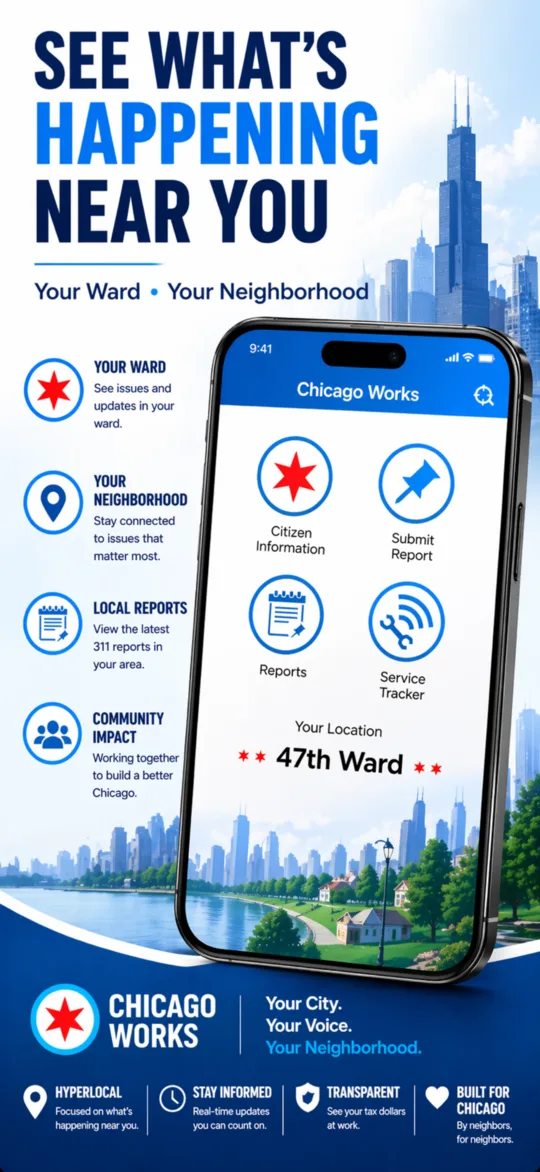
Chicago Works: 311 Reporter has been filing Chicagoans' requests since 2012 and has been featured in the Chicago Tribune, CBS 2, WBEZ, and the Chicago Reader. The current app is built around four things:
- 50+ categories — potholes, streetlights, graffiti, missed garbage pickup, rodent baiting, abandoned vehicles, fallen trees, water leaks, snow-covered sidewalks, stray animals, aircraft noise, and more.
- Auto-locate with ward detection — GPS pins the spot, identifies the Chicago ward, and lets you drag the pin for precision.
- Service Tracker — real-time request status pulled from the city's system: open, in progress, closed.
- Offline-first — start a report with no signal; it syncs when you're back online.
Privacy is part of the design too: your email and address are used only for the 311 filing itself — nothing is sold or shared. The app is free, with an optional paid upgrade to remove ads.
If you want the per-issue playbooks, start with the guides: reporting a pothole, getting graffiti removed free, or requesting rodent baiting.
Put Chicago 311 in your pocket
50+ categories, photo-first reports, automatic ward detection, real-time tracking. Chicago Works is the fastest way to file with Chicago 311 from your iPhone.
Download on theApp Store Free · iPhone & iPad · Also on Google Play · Works in all 50 wards