 Chicago Works
How to Report a Fallen Tree or Branch in Chicago
After every big Chicago storm, the Bureau of Forestry works from a queue of 311 reports — trees down, limbs dangling, branches blocking alleys. Here's how to file yours correctly, and when it's a 911 problem instead.
First: is it an emergency?
Sort the situation before you reach for 311:
- Tree or limb on power lines, or lines down — stay far away and treat it as an emergency: call 911 for immediate danger, and report the wires to ComEd. Don't file this as a routine 311 tree request and walk away.
- Tree blocking a street, alley, or sidewalk, or resting on a car or house — this is urgent 311 territory; crews prioritize blockages and hazards.
- Fallen branch on the parkway, hanging “widow-maker” limb, storm debris — standard 311 forestry requests.
Whose tree is it? (It matters)
The Bureau of Forestry maintains trees on the public way — most importantly parkway trees, the ones growing in the strip between the sidewalk and the curb, plus trees in alleys and on other city property. Those are the city's to trim and remove, and 311 is how you trigger it.
A tree wholly on private property is the owner's responsibility, even if it's leaning ominously — that's a conversation (or a certified arborist), not a city crew. The common gray area: a private tree's limb falling onto the public way. Report what's blocking the public way, and the city will handle its side of it.
How to file the forestry request
Call 311 (312-744-5000 from outside the city), use 311.chicago.gov, or file through an Open311 app like Chicago Works. Pick the request that matches what you see — tree down / fallen branch, hanging or broken limb, or tree debris — and include:
- Exact location — address or intersection, and whether the tree is on the parkway, in the alley, or leaning from a yard.
- What it's blocking — street, sidewalk, alley, bike lane — since blockages jump the queue.
- A photo, which shows crews the size of the job (a chainsaw crew vs. a full removal with a chipper).
What happens after you file
Your report gets a service request (SR) number and Forestry triages it — hazards and blockages first, routine debris after. Post-storm, volumes spike citywide and the queue runs long; the request statuses (open, in progress, closed) are how you see where you stand. Related requests — tree trims for limbs scraping buses, stump grinding after a removal — go through 311 the same way.
Filing it with Chicago Works
Storm damage reporting usually happens on a walk around the block, and that's where Chicago Works shines:
- Photograph the tree or limb from a safe distance.
- Auto-locate — GPS pins the spot and detects your ward; drag the pin onto the exact parkway or alley position.
- Pick the fallen-tree category and submit — straight into the city's official Open311 queue. Storm knocked out your signal? The report saves offline and syncs when you're back online.
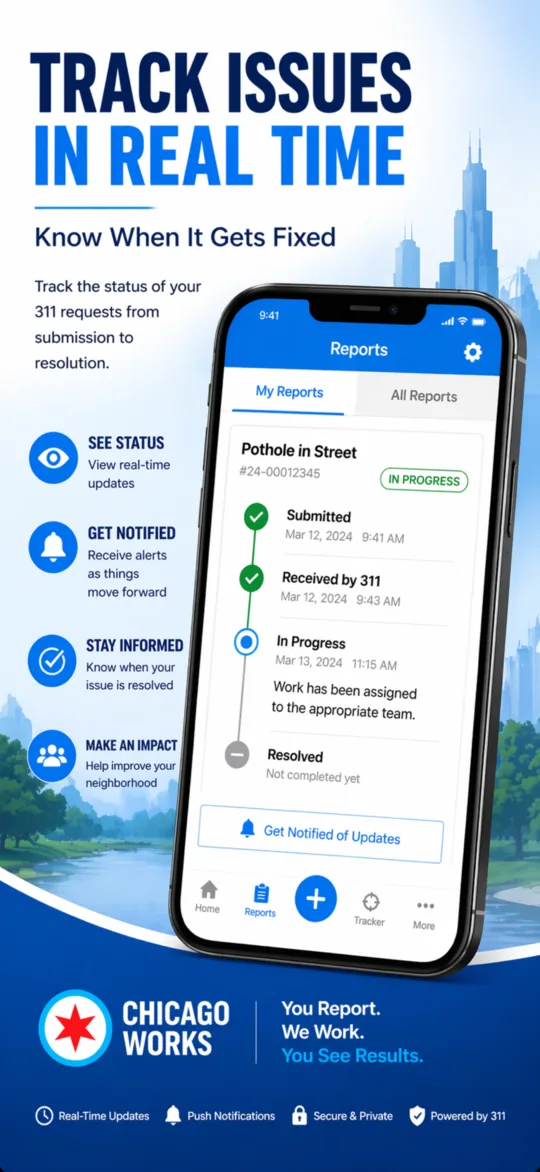
The Service Tracker then follows the request through the city's system, so you'll know when the crew is scheduled and when the parkway is finally clear.
Get Forestry to your block
Snap the downed limb, let GPS pin the spot, submit — Chicago Works routes it into the city's Open311 queue and tracks it until crews clear it.
Download on theApp Store Free · iPhone & iPad · Also on Google Play · Works in all 50 wards